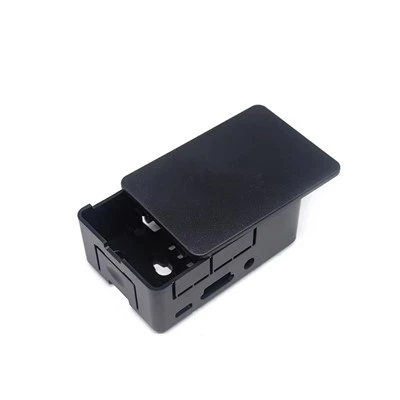
Why are transparent injection molded parts like PC and PMMA so prone to issues? What are the key structural design considerations for transparent parts? Why, even though both are transparent materials, is PC significantly more impact-resistant than PMMA?
- What are the key structural design considerations for transparent injection molded parts like PC and PMMA?
- Why, even though both are transparent, are parts made from PC significantly more impact-resistant than those made from PMMA?
There are actually quite a few types of plastics used for transparent plastic parts, but acrylic (PMMA) and polycarbonate (PC) are indeed the most commonly selected and widely used transparent materials. The structural design of transparent injection molded parts requires great care, as slight oversights can turn a product from crystal clear to flaw-ridden, presenting many "potential pitfalls" that need to be avoided in design. If you've repeatedly adjusted the injection molding process for your transparent part and are still unsatisfied with the results, it's highly likely that the problem lies in the structural design of the part itself.
Wall thickness design is the primary consideration for transparent injection molded parts, as the most significant issue for transparent parts is abrupt changes in wall thickness. This can cause uneven light refraction, leading to obvious streaks of light and shadow. The ideal design should maintain uniform wall thickness, with a gradient change controlled to no more than 0.5mm per 10mm. For acrylic (PMMA) products, the recommended wall thickness range is 3-8mm; for PC parts, it can be slightly thinner, typically 2-6mm. It's especially important to design sufficient fillet radii at corners, with a minimum radius of at least 0.5 times the wall thickness. Otherwise, stress whitening can occur during injection molding.
Next is the draft angle. The control of the draft angle for transparent parts is particularly critical. Transparent parts have stricter requirements for draft angles than ordinary plastic parts, generally requiring 1.5-3°. The draft angle on the fixed (cavity) side should be 0.5° larger than on the moving (core) side. This detail effectively helps prevent scratches during ejection. For deep-cavity transparent parts, the draft angle may even need to be increased to 5° or more. It's especially important to note that any design involving negative draft angles is absolutely prohibited, as it will directly cause surface damage to the part during ejection.
Then there are the gate and runner. The gate design for transparent parts directly affects the optical result. Direct gates must be avoided for transparent parts, as they leave obvious weld lines on the surface. Submarine (tunnel) gates or fan gates are better choices, but gate dimensions need to be precisely calculated-too small leads to short shots, too large creates flow marks. Experience shows that the gate thickness should be controlled at 50-70% of the part's wall thickness, and the width is recommended to be 2-3 times the wall thickness. For large transparent parts using multiple gates, a balanced runner system is crucial to ensure the melt flow front advances uniformly.
Furthermore, the handling of structural connections in transparent parts requires extra caution. Direct screw fastening should be avoided for transparent parts whenever possible, as it creates significant stress concentration. Chemical bonding or mechanical snap-fit methods are recommended. If screws must be used, sufficient stress-relief grooves should be designed around the screw bosses. The choice of adhesive is also key. While UV-curing adhesives are convenient, they are prone to yellowing over time. Optically clear epoxy resins are recommended; although they have longer curing times, they ensure lasting clarity and bond strength.
If your transparent part requires surface treatment, Many people believe transparent parts require high-level polishing, but in reality, excessive polishing can actually make surface scratches more visible. The professional approach is to use a diamond polishing process, achieving an SPI A2 grade finish. Another misconception is using ordinary anti-scratch coatings, which can cause light scattering. The correct method is to choose a nano-coating that matches the refractive index, which protects the surface without affecting light transmittance.
Additionally, the requirements for mold design for transparent parts are nearly stringent. The mold core and cavity for transparent parts must be made of mirror-polish steel (such as S136H), with a hardness of HRC 52 or higher. The cooling system design must be even more meticulous; conformal cooling channels are recommended to ensure mold temperature fluctuations are controlled within ±1°C. The venting system also cannot be ignored; venting grooves of 0.02-0.03mm should be set at the last areas to fill, which is crucial for avoiding silver streaks. It's worth mentioning that considerations for the use environment of transparent parts are often overlooked. Acrylic (PMMA) yellows under prolonged UV exposure. PC has better UV resistance, but is prone to stress cracking in high-temperature environments. Design should avoid directly exposing transparent parts to harsh environments; UV stabilizers should be added when necessary. Thermal expansion due to temperature changes also cannot be ignored. Sufficient expansion gaps must be provided for the installation of transparent parts, typically 0.5mm per 100mm of length.
Finally, emphasize that validation testing before mass production of transparent parts is essential. In addition to routine dimensional inspection, transparent parts specifically require optical distortion testing, stress birefringence testing, and weatherability testing. It is recommended to use a polariscope to inspect internal stress distribution; areas of stress concentration will display colored fringes. Accelerated aging tests should simulate at least 3 years of use, which is an effective method for uncovering potential issues.
Having covered a lot, let's summarize : The structural design of transparent injection molded parts should avoid abrupt wall thickness changes, strictly prohibit negative draft angles, use metal inserts cautiously, stay away from sharp corners, and control the location of weld lines. Incorporating these key points into design specifications is the way to create beautiful and reliable transparent plastic parts. Good transparent part design should achieve standards like: light transmittance loss less than 5%, surface haze below 1%, and resistance to yellowing for 5 years under normal use conditions.
Next, let's discuss why, even though both are transparent materials, PC is much more impact-resistant than PMMA?
Indeed, among transparent plastics, PMMA (acrylic) and PC (polycarbonate) are often compared: both are transparent, both can be injection molded, and both can be used for optical parts. But when it comes to "impact resistance," the difference is almost overwhelming. Let's first look at a set of data:
PMMA Impact Strength: Approximately 2-10 kJ/m²
- PC Impact Strength: Can be as high as 60-80 kJ/m² (or even higher)
What does this mean?
Under the same heavy impact, PMMA is likely to shatter upon impact, while PC can twist, deform, and "absorb" the impact energy, remaining unbroken itself.
Why, even though both are transparent plastics, is there an order of magnitude difference?
Today, we'll break down this seemingly simple yet profound question, from the essence of impact → molecular structure → chain segment movement → physical mechanism.
Many people think impact resistance is about "hardness." It's actually not that at all.
The impact performance of transparent materials essentially comes from three capabilities:
- Ability to undergo strain (plastic deformation): Can the material undergo plastic deformation (like stretching, bending) upon impact, dispersing the energy over an area rather than concentrating it at a point?
- Ability to absorb energy (energy dissipation): Can the material's microstructure (molecular chains, chain segments) dissipate the kinetic impact energy by converting it into other forms of energy (like heat) through mechanisms like slippage, shear, and orientation when subjected to force?
- Ability to allow extensive plastic deformation without losing transparency: This is the ultimate challenge for transparent engineering plastics. Many materials can absorb energy, but once stretched, they develop crazing (stress whitening), causing light scattering and loss of clarity. Top-tier transparent, impact-resistant materials must achieve "transparent yielding."
PC excels in all three aspects, while PMMA has inherent shortcomings in the first two.
Let's start by looking at PMMA.
PMMA's "high rigidity" among transparent materials was once an advantage: suitable for optics, suitable for support, not prone to deformation. But this also laid the groundwork for its "poor impact resistance."
- PMMA's chains are very rigid, and its side groups are too large:
PMMA's structure contains a "massive" side group: -COO–CH₃ (methyl ester group)
This large side group has significant steric hindrance, leading to:
- Difficulty for chain segments to twist
- Difficulty for molecules to slip
- Severely restricted localized motion
- It's like driving wedges between the chain segments, severely hindering the rotation and slippage of molecular chains.
- PMMA has a very high glass transition temperature (Tg):
PMMA's Tg ≈ 105°C.
At room temperature, which is far below this temperature, its molecular chain segments are in a "frozen" glassy state with extremely poor mobility.
- PMMA lacks a structure that "resists crack propagation":
PMMA molecular chains are regular. Once microcracks form under stress, the crack tip rapidly concentrates energy and propagates like lightning along the molecular chains almost unimpeded. Its fracture is typical brittle fracture-small strain, fast fracture, and extreme sensitivity to notches.
PMMA is like a piece of delicate, hard glass, with ample rigidity, but upon impact, its "locked" chain segments cannot dissipate energy through movement. It can only "resist rigidly" until it shatters.
Now, let's look at PC. PC's molecular structure perfectly illustrates what it means to be "both rigid and flexible."
Its structure is composed of Bisphenol A + carbonate groups, and this structure has two key features:
- Benzene ring + carbonate → high chain rigidity, but not locked:
PC's chains contain many benzene rings, but these rings are not "stiffly stuck." Instead:
The benzene rings provide strength and rigidity, while the carbonate groups act as flexible "joints," allowing the molecular chains to undergo significant rotation and bending under stress. This provides high rigidity (maintaining transparency/strength) while also having flexible chain segments (providing toughness).
- PC's core capability: Yielding deformation for energy absorption:
This is the core mechanism of PC's high toughness. Under force, PC does not fracture directly like PMMA. Instead, it first undergoes yielding.
Molecular chains slip and orient, forming numerous shear bands. The formation of each shear band consumes a significant amount of energy, acting like an efficient internal energy absorber.
PMMA is a piece of hard glass; PC is a piece of steel plate that can stretch transparently.
- Crack propagation in PC is "intercepted" by shear bands:
This is the decisive difference. The manifestation is as follows:
- PMMA: Once a crack forms, it propagates in a straight line, rapidly penetrating the material.
- PC: When a crack attempts to propagate in PC, it encounters not a smooth path ahead, but a network of crisscrossing shear bands and plastic deformation zones. These zones blunt the crack tip, disrupt its propagation path, and absorb its energy, ultimately causing the crack to "exhaust itself" and stop.
Finally, let's summarize the difference in toughness between these two transparent materials, PC and PMMA:
- PMMA consists of high-rigidity chains "locked" by bulky side groups, leading only to brittle fracture.
- PC consists of rigid-skeleton chains with "flexible joints," capable of efficiently absorbing energy through yielding plastic deformation.
This structural difference results in an average 8-10 times or greater gap in impact strength in their macroscopic properties. Consequently, their application choices are also quite different:
- PC dominates in areas requiring high toughness, impact resistance, and durability: e.g., riot shields, safety glasses, automotive headlamp lenses, drone gimbal covers, and drop-resistant casings for electronic devices.
- PMMA excels in areas where high surface hardness, scratch resistance, good weatherability, and excellent optical properties are paramount: e.g., automotive taillight lenses, optical lenses, light guide plates, advertising light boxes, and aquariums.